Review[5]
Reviews therapeutic hypotheses and translational limitations of MOTS-c research.
MOTS-c: A promising mitochondrial-derived peptide for therapeutic exploitation.
Frontiers in endocrinology · 2023
PubMed ↗ (opens in a new tab)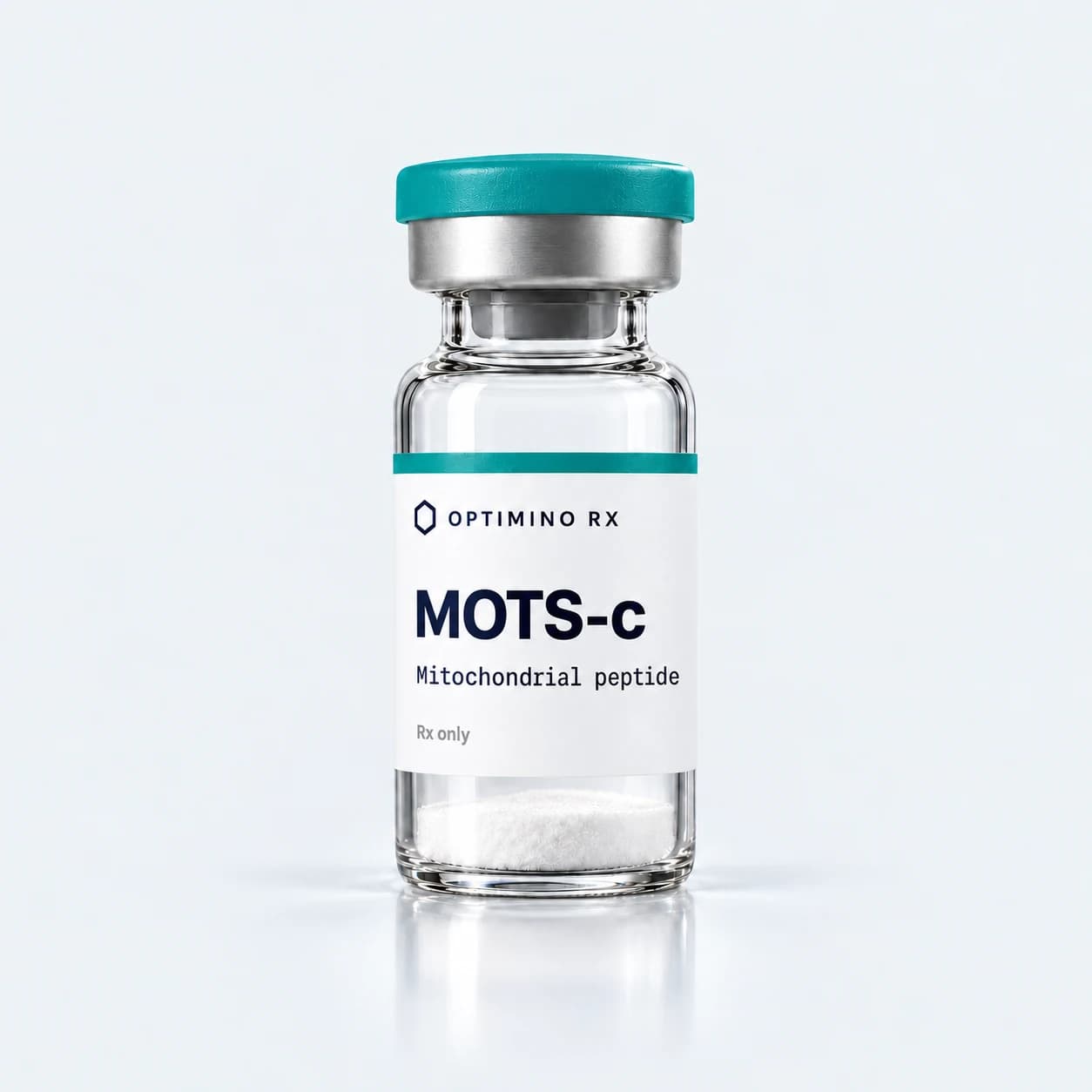
Weight & Metabolic
Mitochondrial metabolism
A mitochondrial-derived peptide that supports insulin sensitivity, energy and exercise capacity.
Ships as a freeze-dried powder. Need water to mix it? Add Reconstitution Solution.
The science
Evidence level
1/5
Preclinical
Strong mouse data and human exercise observations; injected MOTS-c has not yet been tested in controlled human trials.
3 of 33
age groups of mice with significantly better physical performance
23.5 mo3
age at which late-life treatment still raised capacity and healthspan in mice
AMPK1
master energy sensor activated through the folate–purine pathway
Mechanism of action
Targets & pathways
MOTS-c is a 16-amino-acid peptide encoded in mitochondrial DNA, evidence that mitochondria actively signal to regulate metabolism at the cellular and whole-body level1.
It inhibits the folate cycle and the de novo purine synthesis tethered to it, activating AMPK, the cell’s master energy sensor1.
Under metabolic stress, MOTS-c moves into the nucleus and regulates adaptive, antioxidant-response genes2.
Exercise raises MOTS-c in human muscle and blood; in mice, treatment improved performance across ages and extended healthspan when started late in life3.
What the research shows
In mice, MOTS-c prevented high-fat-diet-induced obesity and insulin resistance, along with age-dependent insulin resistance.
Treated mice performed significantly better whether young (2 months), middle-aged (12 months) or old (22 months).
Started at 23.5 months, intermittent dosing three times a week increased physical capacity and healthspan in old mice.
In humans, exercise raised MOTS-c in skeletal muscle and circulation, pointing to a natural role in exercise adaptation.
Reviews therapeutic hypotheses and translational limitations of MOTS-c research.
MOTS-c: A promising mitochondrial-derived peptide for therapeutic exploitation.
Frontiers in endocrinology · 2023
PubMed ↗ (opens in a new tab)Reviews the peptide’s mitochondrial origin and experimental muscle and fat metabolism.
MOTS-c: A novel mitochondrial-derived peptide regulating muscle and fat metabolism.
Free radical biology & medicine · 2016
PubMed ↗ (opens in a new tab)Mouse performance experiments covered young, middle-aged and old animals; human exercise observations measured endogenous peptide responses.
MOTS-c is an exercise-induced mitochondrial-encoded regulator of age-dependent physical decline and muscle homeostasis.
Nature communications · 2021
PubMed ↗ (opens in a new tab)Questions
MOTS-c research concerns a mitochondrial-derived metabolic signal. SS-31 binds cardiolipin and has a narrow branded FDA approval for Barth syndrome; that does not prove wellness benefit.
No. An exercise-induced endogenous signal does not establish that giving the signal reproduces the whole response to exercise.
The administered-treatment physical-performance findings cited here are in mice.
Mouse data support a hypothesis, but do not establish a clinical glucose-lowering effect of this product.
They support the relevance of endogenous biology while leaving injection efficacy and safety unanswered.
 Weight & Metabolic
 Weight & Metabolic
 Weight & Metabolic
 Weight & Metabolic